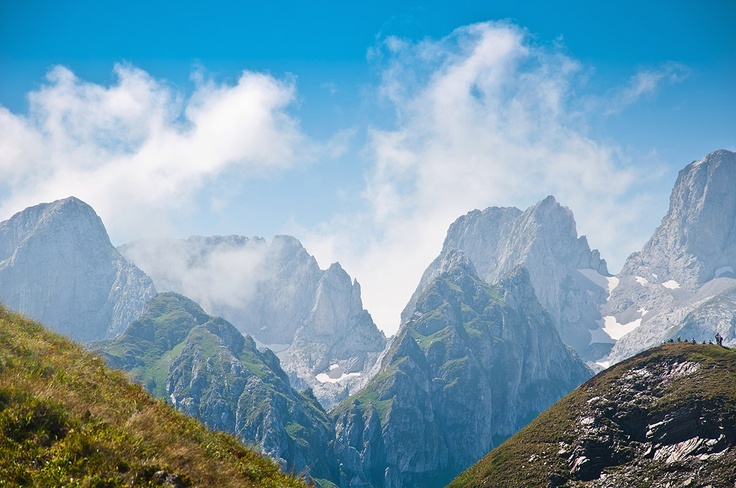
A recent report from geographers at the University of Manchester details the discovery of four previously unknown glaciers in the Albanian part of the Prokletije range at 1980?2100 m high, found in the area close to Maja e Jezerces. The glaciers, the largest of which is currently the size of six football pitches, vary in size every year according to the amount of winter snowfall and temperatures during the following summer. Their average total surface area is 5 hectares (0.019 sq mi). Glacier-climate modeling suggests that these glaciers require annual accumulation of between 4,137 and 5,531 millimetres (162.9 and 217.8 in) (rainfall equivalent) to balance melting, which would correspond to between 49.7 and 66.4 metres (163.1 and 217.8 ft) of snow. A significant proportion of this accumulation is likely to be sourced from windblown snow and, in particular, avalanching snow. It is estimated that the total accumulation needed to balance melting is potentially up to twice the amount accumulated from direct precipitation.[citation needed ] The presence of these glaciers, the southernmost in Europe, at altitudes well below the regional snow line highlights the importance of local controls[clarification needed ] on glacier development. The geographers think at least eight glaciers were present in neighbouring mountains[clarification needed ] during the 19th century, correlating with the culmination of the 'Little Ice Age' in the European Alps.[15]