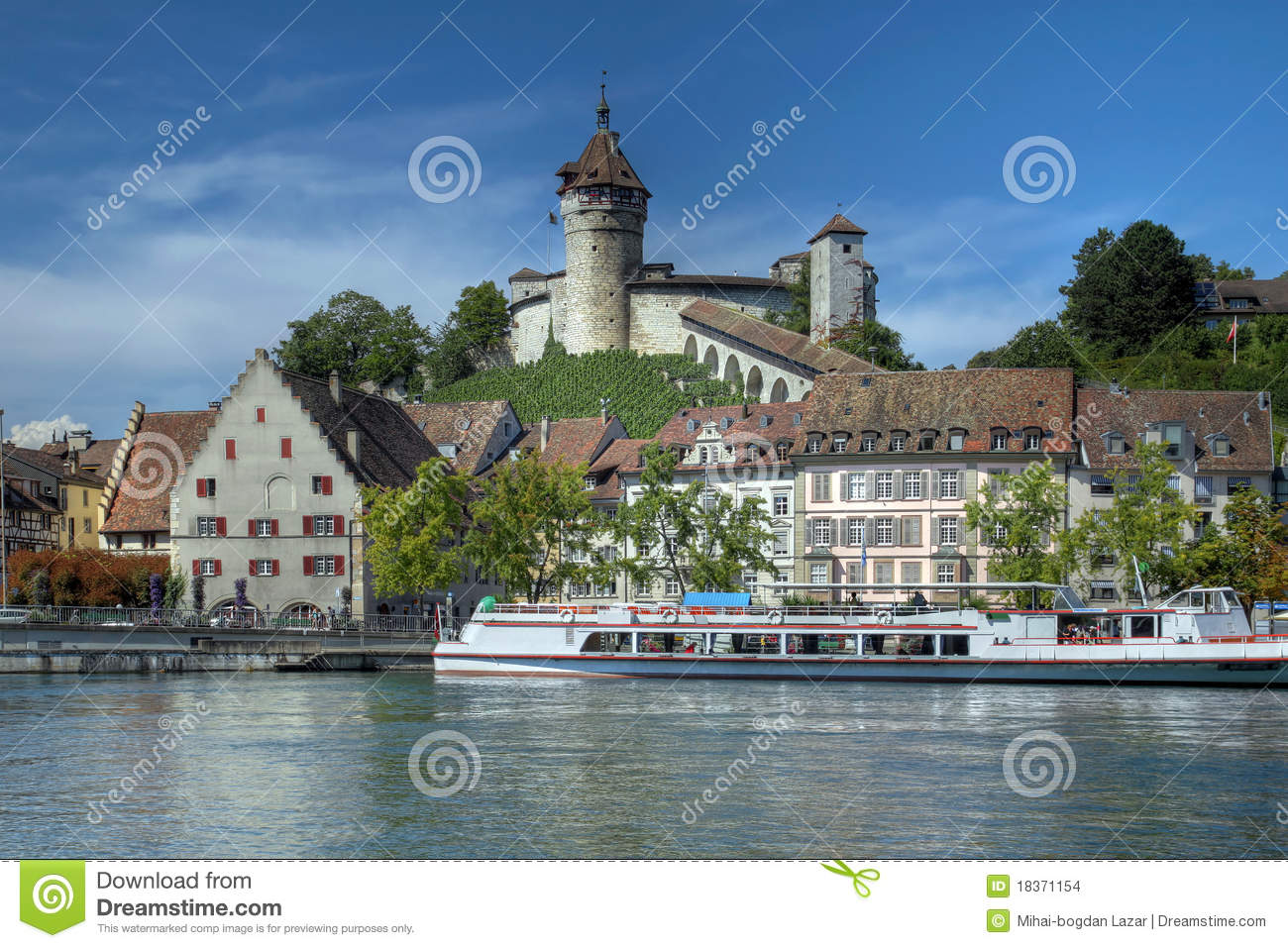
Schaffhausen is a city in northern Switzerland and the capital of the canton of the same name; it has an estimated population of 34,587 as of December 2008. The old portion of the city has many fine Renaissance era buildings decorated with exterior frescos and sculpture, as well as the impressive old canton fortress, the Munot. A train runs out of town to the nearby Rhine Falls in Neuhausen am Rheinfall, Europe's largest waterfall, a tourist attraction. The town is first mentioned in 1045 as Villa Scafhusun. There are at least two theories on the origin of this name. One is related to a mention of a ford across the Rhine River that first occurs in 1050. This ford may actually refer to a scapha or skiff which was used to disembark goods coming from Constance to move them around the Rhine Falls. The name Scafhusun then arose from the scapha used at that point. Another theory is that Scafhusun comes from Schaf (a sheep), as a ram (now a sheep) formed the ancient arms of the town, derived from those of its founders, the counts of Nellenburg. The blazon of the municipal coat of arms is Or on a Base Vert issuant from sinister a Semi Castle Argent with tower with entrance from which is issuing a Semi Ram Sable. The canting coat of arms refers to the second interpretation of the name, sheep-house. Schaffhausen was a city state in the Middle Ages, documented to have struck its own coins from 1045. About 1050 the counts of Nellenburg founded the Benedictine monastery of All Saints, which became the center of the town. Perhaps as early as 1190, certainly in 1208, it was an imperial free city, while the first seal dates from 1253. The powers of the abbot were gradually limited and in 1277 the Emperor Rudolf I gave the town a charter of liberties. In 1330 the emperor Louis of Bavaria pledged it to the Habsburgs. In the early 15th century, Habsburg power over the city waned. By 1411 the guilds ruled the city. Then, in 1415 the Habsburg Duke Frederick IV of Austria sided with the Antipope John XXIII at the Council of Constance, and was banned by the Emperor Sigismund. As a result of the ban and Frederick's need of money, Schaffhausen was able to buy its independence from the Habsburgs in 1418. The city allied with six of the Swiss confederates in 1454 and allied with a further two (Uri and Unterwalden) in 1479. Schaffhausen became a full member of the Old Swiss Confederacy in 1501. The Reformation was adopted, initially, in 1524 and completely in 1529. The town was heavily damaged during the Thirty Years' War from the passage of Swedish (Protestant) and Bavarian (Roman Catholic) troops and the very important bridge was burnt down. It was not till the early 19th century that the arrested industrial development of the town took a fresh start. In 1857 the first railroad, the Rheinfall-Bahn running from Winterthur, reached Schaffhausen. The Nazi war criminal Karl Jäger was born in Schaffhausen, though he spent most of his adult life in Germany, as soldier, an early member of the Nazi party and the SS, and an Einsatzkommando leader responsible for the mass murder of Jews in Lithuania, 1942. Schaffhausen is located in a finger of Swiss territory surrounded on three sides by Germany. On April 1, 1944, Schaffhausen suffered a bombing raid by US Army Air Force aircraft which strayed from German airspace into neutral Switzerland due to navigation errors. About a hundred civilians were killed; the United States immediately offered a million dollars in reparations. Schaffhausen has an area, as of 2006, of 31.1 square kilometers (12.0 sq mi). Of this area, 20.7% is used for agricultural purposes, while 47.2% is forested. Of the rest of the land, 30.2% is settled (buildings or roads) and the remainder (1.9%) is non-productive (rivers or lakes)