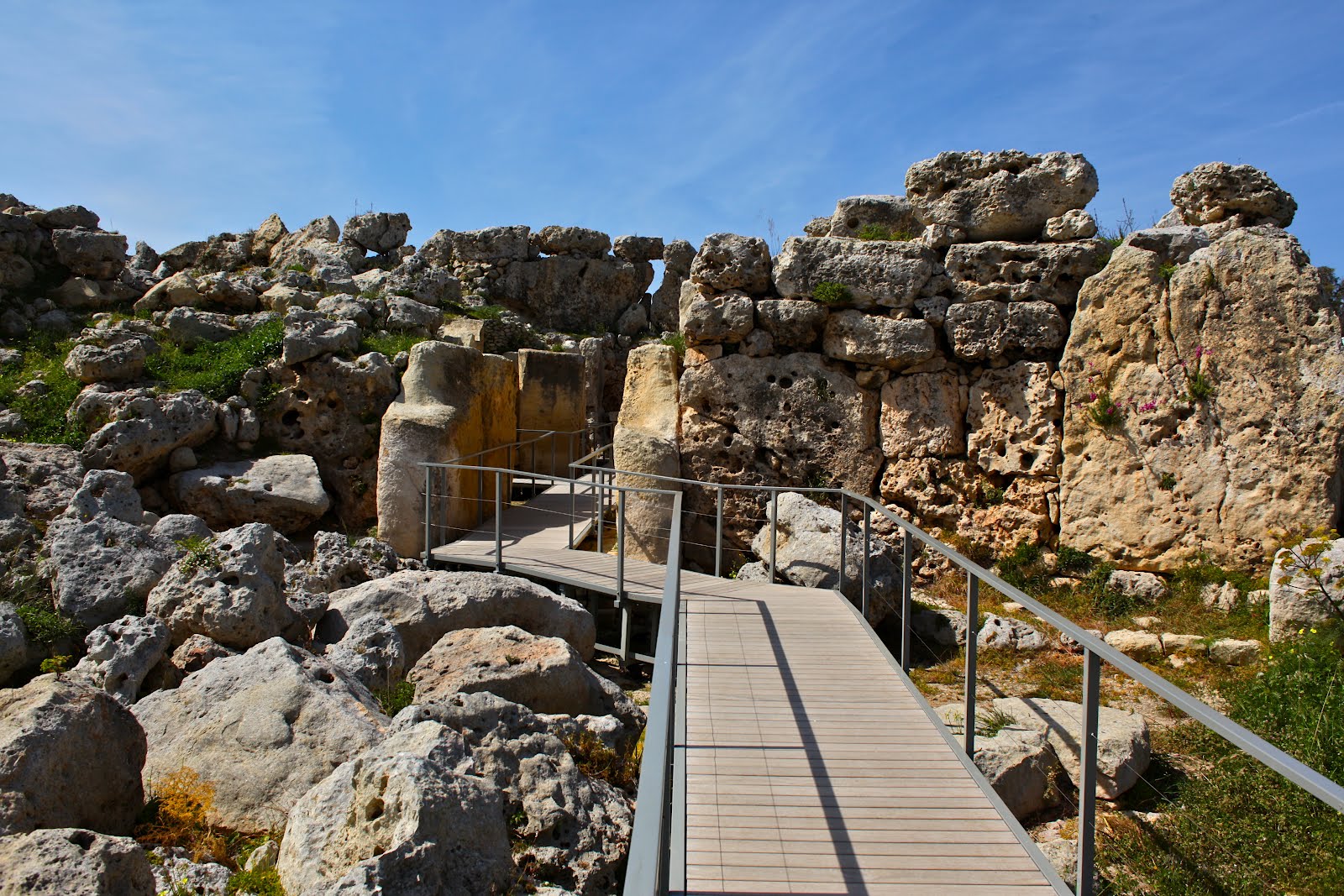
The importance of this site lies less in the remains than in the information garnered from their excavations.[51] This monument has a typical three-apsed shape of the ?gantija phase, of which the greater part of the first two apses and the whole of the façade have been destroyed to ground level. What remains are the stone paving of the entrance passage, with its perforations, the torba floors,[52] and a large upright slab of coralline limestone.[53] The north wall is in better shape; originally the entrance opened on a court, but the doorway was later closed off in the Tarxien phase, with altars set in the corners formed by the closure.[54] East of this temple, a second monument was added in the Tarxien phase, with four apses and a central niche.[55] Before the temples were built, the area had supported a village over a period of roughly twelve centuries.