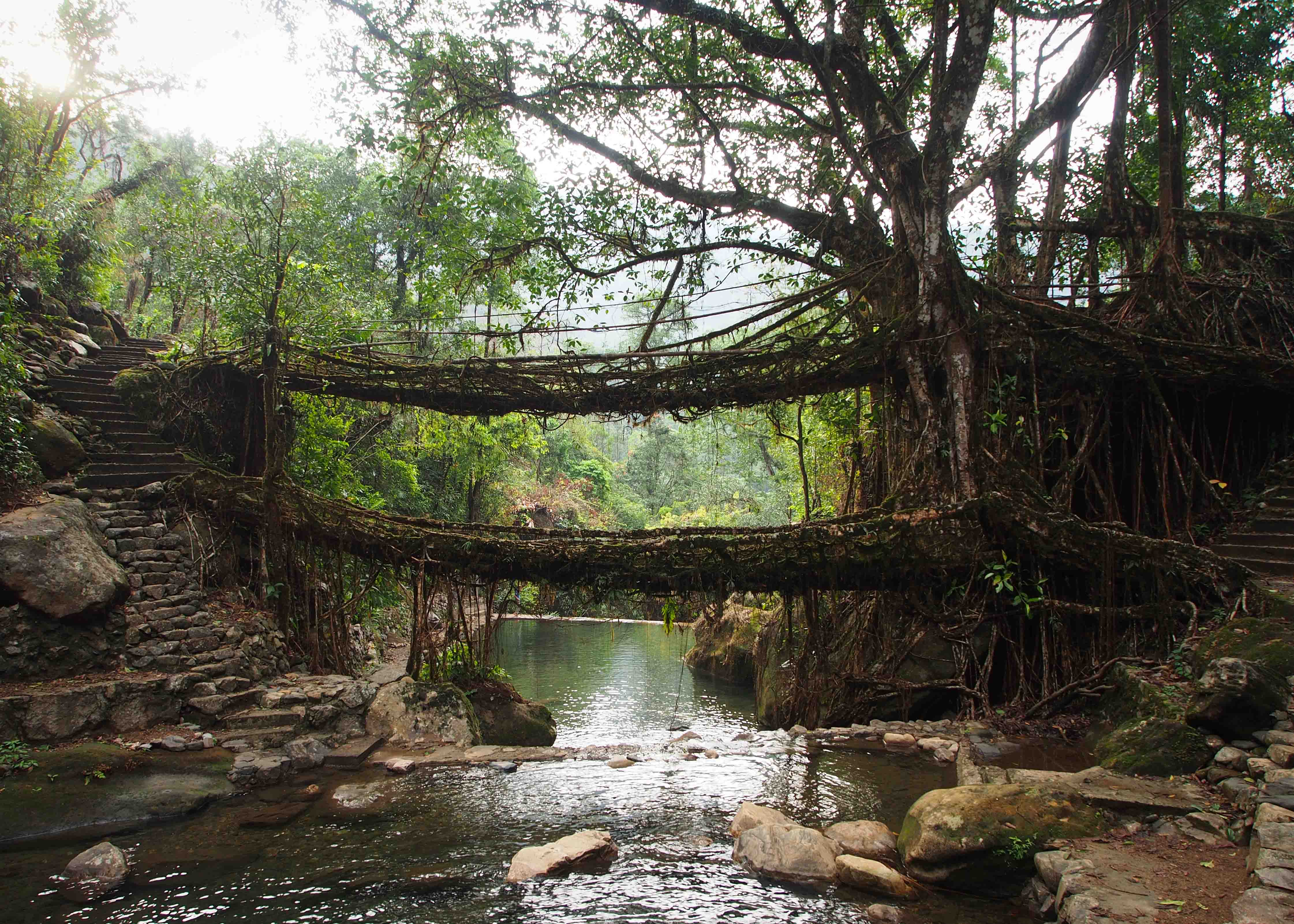
Our ancestors, the early war-Khasis, had noticed these qualities of this tree and had adapted it to serve their need for bridges to cross rivers and streams. In order to direct the roots in the desired direction, betel nut tree trunks, sliced half in the middle for their entire length, are hollowed out and are positioned according to the requirement of the bridge. The thin and long tender roots are then passed through these hollowed out betel nut tree trunks. The roots start growing towards the directed end. When they reach the other end of the stream or river, they are allowed to take root in the soil. These bridges usually have base spans numbering more than two. There are also two protective railing spans. Stones are used to fill any gaps in the base spans and over time they get embedded in the floor of the root bridge. Some of these bridges have roots brought down from the tree branches joining the middle of the bridge as support spans. Some of these root bridges are made by entwining the roots of two trees planted on opposite banks or in the middle of the river on huge boulders.