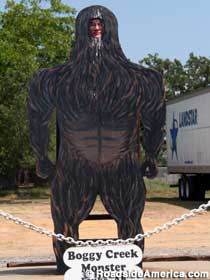
Deep in the swamps of Fouke, Arkansas, there lurks a mysterious creature that has baffled locals for decades - the Boggy Creek Monster. This elusive beast is said to roam the dense forests and marshes surrounding Boggy Creek, leaving behind a trail of fear and curiosity in its wake.
The legend of the Boggy Creek Monster dates back to the 1950s when sightings of a large, hairy creature began to surface in the area. Described as standing over seven feet tall, covered in thick fur, and emitting a foul odor, the monster quickly garnered a reputation as a fearsome and elusive creature.
Many residents of Fouke have reported encountering the creature, with some claiming to have even been chased or attacked by it. Despite numerous attempts to capture or study the creature, the Boggy Creek Monster remains shrouded in mystery, leaving many to wonder about its origins and true nature.
Some theories suggest that the Boggy Creek Monster may be a type of undiscovered primate or a surviving descendant of prehistoric creatures that once roamed the earth. Others believe it could be a cryptid, a creature that exists outside of mainstream science and mythology.
Regardless of its true identity, the legend of the Boggy Creek Monster continues to capture the imagination of locals and visitors alike. Whether you believe in its existence or consider it merely a tall tale, the creature remains a prominent figure in the folklore of Fouke, Arkansas.
Key points about the Boggy Creek Monster:
- The Boggy Creek Monster is said to inhabit the swamps and forests surrounding Boggy Creek in Fouke, Arkansas.
- Descriptions of the creature vary, but it is commonly described as a large, hairy beast standing over seven feet tall.
- Sightings of the monster date back to the 1950s, with numerous reports from locals claiming to have encountered it.
- Despite efforts to capture or study the creature, it remains elusive and mysterious, with no definitive evidence of its existence.
- The legend of the Boggy Creek Monster has inspired books, documentaries, and even a feature film, further cementing its place in local folklore.